


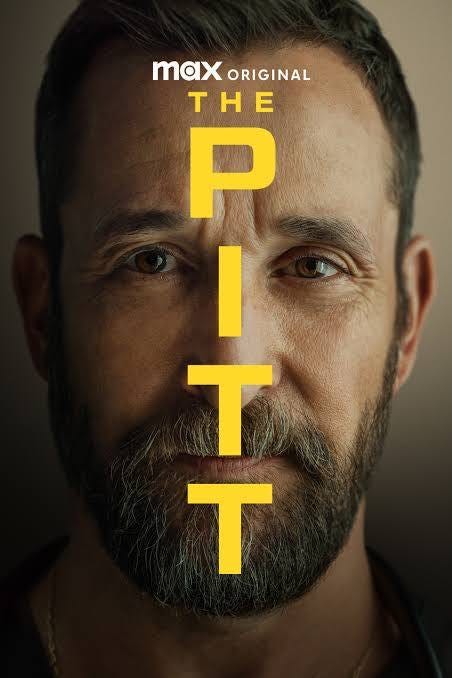
At the end of the first episode of HBO’s new hit drama, The Pitt, my wife, Holly, doubled over on our living room couch and wept.
This is a post about slow burn lament.
My wife is a nurse with a PhD, which means she’s really legit in the medical world. She loves her vocation, and feels about it the way I do about my calling as a pastor. God wanted her to be a nurse, and she knows that he takes great joy in watching her be one.
When you really love your vocation, you often entertain yourself with your discipline. I listen to theology podcasts; Holly listens to medical podcasts.
That’s why she suggested that we give The Pitt a shot—a show about life in an underfunded and understaffed emergency room in Pittsburgh.
everything in this post is shared with Holly’s permission
The episode begins with a mystery: everyone is wondering why the main character (played by Noah Wyle, the former star of NBC’s E.R.) is at work. Something had happened on that particular date—it apparently includes the death of a friend, and the doctor (at least in part) blames himself.
The episode ends with an abrupt and horrific reveal. It’s a flashback to the early days of COVID. Everyone’s in PPE with faces and mouths covered, sweating. The waiting room is overcrowded.
Panic.
These are the scenes Holly lived when she was the Director of Nursing at a nursing home through the pandemic. The first elderly man to get infected coughed right into her face before he tested positive, so Holly contracted it too. She laid in bed for ten days, telling me I might need to go get her an oxygen tank to survive.
The moment she could stand on her own two feet, she had to go back to work. The nursing home was understaffed, and they needed Holly’s leadership to keep up with state and federal guidelines on quarantine.
Because she already had COVID, she self-selected to work the COVID unit, which looked like a zombie apocalypse. The organization was in the middle of a building project, so the only place they had to quarantine the infected was on an unfinished hall that still had make-shift lighting, construction materials laying about, and the guts of the building exposed.
She watched 26 people die in two weeks. Through her face mask she sang old Christian hymns with what little breath she had in her own lungs to provide a modicum of comfort.
That’s why she cried at the end of the first episode of The Pitt (and why we never watched episode two).
I started crying when she did, because I lived it all with her.
Slow Burn Lament
I’m grateful that Evangelicals, Pentecostals, and free church traditions have come in recent years to talk more intentionally about the role of lament in the Christian life. I remember a local Evangelical church here in Iowa City hosting an outdoor event during COVID to lament and pray together about the horrific death of George Floyd. That was a good (and the right) thing to do.
The thing that I still grieve is that the practice of lament is often left to single events, rather than an ongoing, routine practice in the life of the church.
Don’t get me wrong: I’m not asking for a wintry Christianity where all we do is moan about the state of the world. What I think we’re missing is recognizing that lament and joy often happen at the same time. Like when a baby is born the spitting image of his recently-deceased grandfather.
Still another piece that’s missing is recognizing that lament is more often than not a slow burn. It lurks, flavors things like a pinch of salt, and sneaks up on us in moments of profound happiness.
COVID is like that, and worse, for many more people than Holly. The political points pundits continue to score on their opponents about the legitimacy of the measures taken by authorities during the outbreak means that it’s dangerous to lament out loud, even in the supposed safety of friends and family.
Last I checked, most people are still confused if the federal and state governments made the right decisions for the public. And we, the people, still don’t know if we made all the right decisions to keep our loved ones safe.
But what Holly does know (and so many people like her) is that there were 26 precious and beloved people who died under her care, and that’s devastating. Survivor’s guilt (which is real) and the financial crisis that nursing homes continue to find themselves in compounds the grief by orders of magnitude, precisely because people like Holly are called by God.
We need to let ourselves and others lament without judgment. People can have made wrong decisions and have wrong opinions, but their grief is still real and worthy of compassion.
Let others lament like you would like them to let you lament.
A Prayer of Lament
I wrote this prayer early in the outbreak, which is a lament of its own. The prayer works even when there’s no global pandemic, so feel free to pray it in private and in church, and share it freely.
After that, maybe you can try your hand at writing a prayer of lament yourself.
Loving Father,
Your scriptures command us to send the elders of the church to pray for the sick;
To anoint with oil,
and to ask in faith for healing.
Jesus Christ of Nazareth,
You said that as often as we visit the sick person,
we visit you;
Yet we are required out of love for our neighbor,
Not to visit,
Not to touch,
Not to anoint;
Holy Spirit, go where we cannot go, we pray,
And anoint the hands of all medical staff and personnel
who must, at their own risk,
Visit,
touch,
and anoint.
May no evil befall healthcare workers,
May no plague come near their house,
May they be like your servant Phineas,
who stood up and intervened,
and the plague was stayed.
Blessed be God: Father, Son, and Holy Spirit—one God now and forever.
Amen.
Melodie, my wife, hosts guided lament gatherings.
Crying over here for the pain of what we all went through, and what you rightly named as an absence of safety to grieve. Thank you for writing this (lament is so desperately missing from our churches) and for being Holly's support so she can fulfill her calling as well. Thank you, Holly, for being the love of Jesus personified to those precious people under your care and for living out a calling that costs you greatly. May you experience peace and safety and being held by God as you process and grieve and lament. Lament has become a deeply important part of my life, and something I'd like to encourage and instigate and create space for in the church and beyond. NT Wright talks about how the church has forfeited their role in lamenting. Lament is 1/2 of having an imagination of the world to come. When we lament what is not right in the world, we also tell our culture that we also have a vision for what it should look like.